Basecamp has been around since 2004. In internet years, that's ancient -- and in some ways, that's exactly the point. Basecamp was built on a philosophy: less software, fewer features, more focus. It pioneered the "everything in one place" model for project management long before anyone else was talking about it.
But 2026 isn't 2004. Remote teams are larger and more distributed. Decisions happen faster. AI has changed what "automated" actually means. And the tools Basecamp pioneered -- message boards, to-dos, schedules -- are now table stakes, not differentiators.
If you're choosing between Convoe and Basecamp, you're weighing a classic opinionated tool against a new AI-native workspace. Both believe in simplicity over sprawl. But they take very different paths to get there.
Here's an honest breakdown.
What Basecamp Does Well
To understand where Basecamp falls short, you first have to appreciate what it gets right.
Opinionated simplicity. Basecamp doesn't try to be everything. It gives you message boards, to-do lists, file sharing, schedules, and group chat (Campfire). That's it. No custom workflows, no 47-field issue templates, no plugin ecosystem to maintain. For teams that have been burned by over-configured Jira instances, that restraint is genuinely appealing. Flat pricing. Basecamp Pro Unlimited is $299/month for unlimited users, period. For teams of 20+, that's often dramatically cheaper than per-seat tools. The pricing model removes the "do we really need to add this person?" calculation from every hire. Client collaboration. Basecamp has long been the go-to for agencies working with clients. The client-facing project view -- where you control what clients see -- is well-built and has been refined for two decades. Clear structure. Every project in Basecamp has the same anatomy: a message board, a to-do list, a schedule, group chat, files, and an automatic check-in (Hill Charts). Teams always know where to look.Where Basecamp Falls Short in 2026
Basecamp's philosophy of "enough features, nothing more" made sense when the competition was bloated enterprise software. Now the meaningful competition is AI-native tools that do more automatically -- not more through configuration, but more through intelligence.
No AI layer. Basecamp has no AI capabilities of any significance. Action items discussed in Campfire chat stay in Campfire chat. There's no extraction, no summarization, no automatic task creation. Every decision your team makes in conversation requires someone to manually go create a to-do. Chat and tasks are siloed. Campfire is for chatting. To-do lists are for tasks. But the gap between the two is entirely manual. When a conversation in Campfire produces an action item, someone has to go create it. In practice, this means action items get created by the diligent team members and missed by everyone else. No meeting or async standup support. Basecamp's "Automatic Check-ins" ask team members scheduled questions (like "What did you work on today?"), but there's no AI to aggregate, surface blockers, or link responses to active tasks. Dated UX. Basecamp's interface has been updated incrementally over the years but feels noticeably older than modern tools. For teams onboarding younger workers or tech-forward employees, the aesthetics create friction. Limited visibility across projects. Basecamp works well within a single project. Cross-project dashboards and company-wide task visibility are weak. If you're a PM running five projects simultaneously, context-switching between them inside Basecamp is clunky.What Convoe Does That Basecamp Doesn't
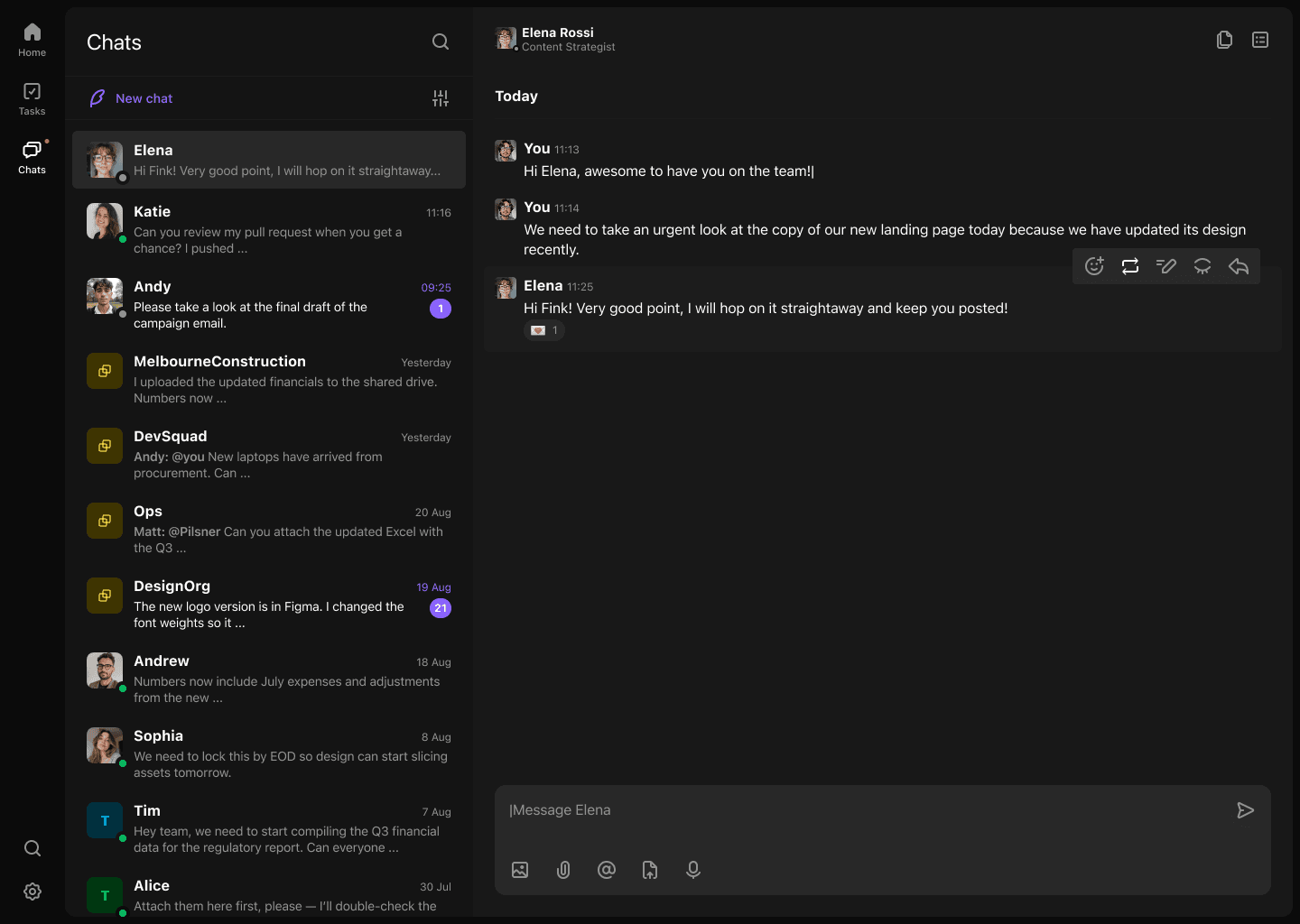
Convoe is built on a premise Basecamp never prioritized: that most team work originates in conversation, and the gap between "we discussed it" and "it's tracked and owned" is where work disappears.
Kai AI captures work from conversation. This is the core differentiator. When your team discusses something in Convoe -- a decision, an action item, a commitment -- Kai extracts it and creates the task automatically. No manual step, no "someone has to go make the to-do." The conversation is the task creation. Decisions have a permanent record. Everything discussed in Convoe is searchable. Six months from now, when your team asks "why did we build it this way?", there's an answer. Basecamp's Campfire chat is searchable too, but the decision is just a message in a thread -- not linked to the work it spawned. Meeting follow-up is automatic. Post a meeting summary in Convoe and Kai extracts the action items, creates tasks, and notifies owners. In Basecamp, the meeting notes live in a Message and the to-dos live somewhere else, connected only by human diligence. Async standups with AI aggregation. Kai prompts team members at their configured time, compiles the digest, surfaces blockers, and escalates -- automatically. Basecamp's Automatic Check-ins collect responses but don't do anything with them beyond displaying them. Single stream for chat and work. In Convoe, chat and tasks aren't separate tabs. A conversation thread can spawn tasks inline. The context -- why the task exists, what was decided -- travels with the task.Feature Comparison
| Feature | Convoe | Basecamp |
|---|---|---|
| AI task extraction from chat | Yes (Kai, automatic) | No |
| Async standup with AI digest | Yes | Partial (no AI layer) |
| Meeting follow-up automation | Yes | No |
| Decision audit trail | Automatic | Manual (search chat history) |
| Chat + tasks in same stream | Yes | Separate (Campfire vs. to-dos) |
| Client-facing project view | Roadmap | Yes (mature feature) |
| Flat pricing model | Per seat | Flat ($299/mo unlimited) |
| Cross-project dashboard | Yes | Limited |
| File sharing | Yes | Yes |
| Message boards | Yes | Yes (Basecamp's core) |
| AI-powered search | Yes | No |
| Integrations | Growing | Limited |
Pricing Comparison
Basecamp Pro Unlimited: $299/month flat, all features, unlimited users. For large teams (30+), this is hard to beat on a per-user basis. Convoe: Priced per seat. For small teams (under 15), typically less expensive than Basecamp. For larger teams, Basecamp's flat pricing may be cheaper -- but the math only makes sense if Basecamp's feature set covers your needs.The hidden cost equation: if you're on Basecamp and still using Slack for "real" chat (because Campfire isn't sticky), Linear or Asana for more robust task management, and a separate tool for async standups -- your effective cost is much higher than $299/month. Convoe consolidates those into one.
Who Basecamp Is Right For
Basecamp remains an excellent choice for specific teams:
Client-service agencies that need a professional client-facing view, have mature processes that don't need AI automation, and value the flat pricing at scale. Teams allergic to configuration. If your last tool was a Jira disaster of 200 custom fields and 14 workflow states, Basecamp's enforced simplicity is a genuine relief. It won't let you over-engineer it. Teams with stable, predictable workflows. If your work is fairly routine -- recurring projects, consistent deliverables, known processes -- Basecamp's to-do lists and message boards handle it cleanly without needing AI. Budget-sensitive teams at scale. At 50+ users, $299/month is exceptional value if the feature set fits.Who Convoe Is Right For
Teams where decisions get lost in chat. If your Campfire (or Slack, or Teams) is full of "I'll look into that" and "can someone make a ticket for this" -- Kai's automatic capture solves that problem directly. Distributed and async-first teams. Convoe's async standup and meeting follow-up automation are built for teams where getting everyone on a call is difficult or wasteful. Fast-moving teams with high decision velocity. Startups, product teams, and growth-stage companies making dozens of decisions per day need those decisions to stick. Convoe creates the audit trail automatically. Teams tired of context-switching. If your current setup has people bouncing between Campfire for chat, a to-do app for tasks, a docs tool for specs, and Zoom for meetings -- Convoe unifies that into one workspace.The Honest Take
Basecamp is a well-made tool that will serve you reliably. It's not trying to win on innovation -- it's trying to win on focus and value. For the right team, it delivers both.
But if your team's core problem is that work discussed in conversation doesn't always become tracked work, Basecamp doesn't solve that. It expects your humans to bridge the gap manually. For teams at speed, that gap is expensive.
Convoe's Kai AI closes that gap automatically. That's not a small improvement -- it's a fundamentally different model of how team coordination works.
---
Priya's marketing agency switched from Basecamp to Convoe six months ago. She'd been on Basecamp for four years and genuinely liked it. The catalyst for switching wasn't frustration with Basecamp -- it was a specific pattern she couldn't ignore.
"Every week in our retrospective, someone brought up a task that fell through the cracks. And every time we traced it back, the moment it was created was a Campfire message. Someone said 'hey can we look into X' and everyone nodded and then nobody made the to-do. That kept happening and Basecamp doesn't have an answer for it."
After switching to Convoe, the conversation-to-task gap closed. "The number of things that 'fell through the cracks' in our first month on Convoe was basically zero. Kai caught things that would have disappeared in Campfire."
She doesn't regret the Basecamp years. "It was the right tool at the right time. But we move faster now and we needed the tool to keep up."
Bottom Line
If you want an opinionated, stable, flat-priced tool for client service work or teams with mature processes -- Basecamp is a safe and solid choice.
If you want AI to handle the overhead of converting your team's conversations into tracked work, Convoe is the better fit for 2026.
Try Convoe free at convoe.com -- no credit card, setup in minutes.---
Related reading:- Replace Slack and Asana With One Tool
- How to Track Meeting Action Items Without Manual Work
- Best Slack Alternatives in 2026
- Convoe vs ClickUp: Which Is Right for Your Team?
- Convoe vs Notion: Chat, Tasks, and Docs in One Place
---
SEO Checklist:- [x] Primary keyword in H1, meta title, meta description, first 100 words
- [x] Secondary keywords distributed naturally
- [x] 2,200+ words
- [x] Balanced honest comparison (not pure puff piece)
- [x] Feature comparison table
- [x] Named story (Priya)
- [x] "Who X is right for" sections
- [x] 5 internal links
- [x] 2 contextual CTAs