Here's the honest version of this comparison.
Asana is good at what Asana does. If you need a structured place to manage projects, assign tasks, and track progress, Asana works. It's been around for years, it's stable, and millions of teams use it.
The problem isn't Asana. The problem is that Asana doesn't solve the gap between where your team talks and where work gets tracked.
Every team using Asana is also using a separate chat tool. Usually Slack or Microsoft Teams. That combination costs $19.74/user/month minimum, and it still requires someone to manually create every single task in Asana after it's been discussed in chat. The two tools don't talk to each other. Every action item is a five-step manual process away from becoming tracked work.
Convoe vs Asana is a comparison about more than features. It's about whether your team's workflow requires a constant manual bridge between communication and task management, or whether that bridge can be automatic.
This article compares both tools honestly, including where Asana wins, so you can make an informed decision.
---
What Asana does well
Asana is a mature, full-featured project management tool. It has been doing this since 2008, and it shows.
Project structure and views. Asana offers boards, lists, timelines, and calendar views. For teams managing complex projects with dependencies, milestones, and portfolios, Asana's structure is hard to beat. You can build a multi-project program view that gives leadership visibility across the whole company. Custom fields and automations. Asana's rules engine is powerful. You can automate task assignments, status changes, due date adjustments, and more based on triggers. For teams with repeatable processes, this reduces manual admin significantly. Third-party integrations. Asana integrates with hundreds of tools: Slack, Google Drive, Salesforce, Jira, Zoom, and more. If your team runs on a specific stack, Asana almost certainly has an integration for it. Reporting and dashboards. For project managers who need to report upward, Asana's reporting features are solid. Workload views, goal tracking, and custom dashboards give managers real visibility into project health.If you're running a large organisation with complex project structures and significant reporting requirements, Asana is a reasonable choice.
---
Where Asana falls short
Despite its strengths, Asana has three structural gaps that affect almost every team that uses it.
No native team chat
Asana has task comments. That's not chat.
Every team using Asana needs a separate tool for team communication. Usually Slack. That means:
- Conversations happen in Slack
- Tasks are created in Asana
- Someone has to manually bridge every action item from one to the other
- That bridging step fails 40% of the time, by most estimates
This isn't a minor inconvenience. It's the primary reason tasks get lost. When your communication tool and your task tool are separate applications, every commitment made in chat requires a manual transfer. Most teams do that transfer inconsistently at best.
Manual task creation by default
Asana Intelligence, Asana's AI layer, can summarise conversations and auto-populate some task fields. It does not automatically create tasks from chat messages. Someone still has to open Asana, click "create task," fill in the details, and set the assignee and deadline.
For a team generating 20-30 action items per day, that's significant daily admin. Research from the University of California, Irvine shows the average knowledge worker switches applications 1,200 times per day. Every Slack-to-Asana manual task creation is another switch.
Pricing that adds up
Asana's pricing starts at $10.99/user/month for the Starter plan, which includes basic project management. But to access timeline views, dependencies, and AI features, you need Premium ($24.99/user/month) or Business ($30.49/user/month).
Combine Asana Starter ($10.99) with Slack Pro ($8.75) and you're at $19.74/user/month for a stack that still requires manual task bridging. Add in Google Workspace for calendar ($7.20/user) and you're at $26.94/user/month before any AI features.
For a team of 20, that's $6,465.60 per year for tools that don't talk to each other.
---
Where Convoe wins
Convoe was built specifically to solve the gap that Asana and Slack together cannot close.
AI task creation from conversation
Kai, Convoe's AI assistant, reads team conversations in real time and automatically creates tasks with assignees, deadlines, and context. This is the core differentiator.
When your team discusses work in Convoe channels, tasks don't wait for someone to create them. They appear on the project board as the conversation happens.
A practical example: the sales team at a small agency is wrapping up a client call debrief in their Convoe channel.
"Client wants the revised proposal by next Wednesday. Tom, can you update the pricing section? Rachel, grab the new case studies from the marketing folder and attach them. I'll pull the final version together Tuesday evening for a Wednesday morning send."
Kai reads that message and creates:
- Task: Update proposal pricing section, assigned to Tom, due Tuesday
- Task: Attach case studies to proposal, assigned to Rachel, due Tuesday
- Task: Finalise and send proposal, assigned to (the sender), due Wednesday
Three tasks, correct assignees, correct deadlines. No one opened Asana. No one copied anything. The conversation became tracked work instantly.
See how Kai creates tasks from conversations.Chat and tasks in one app
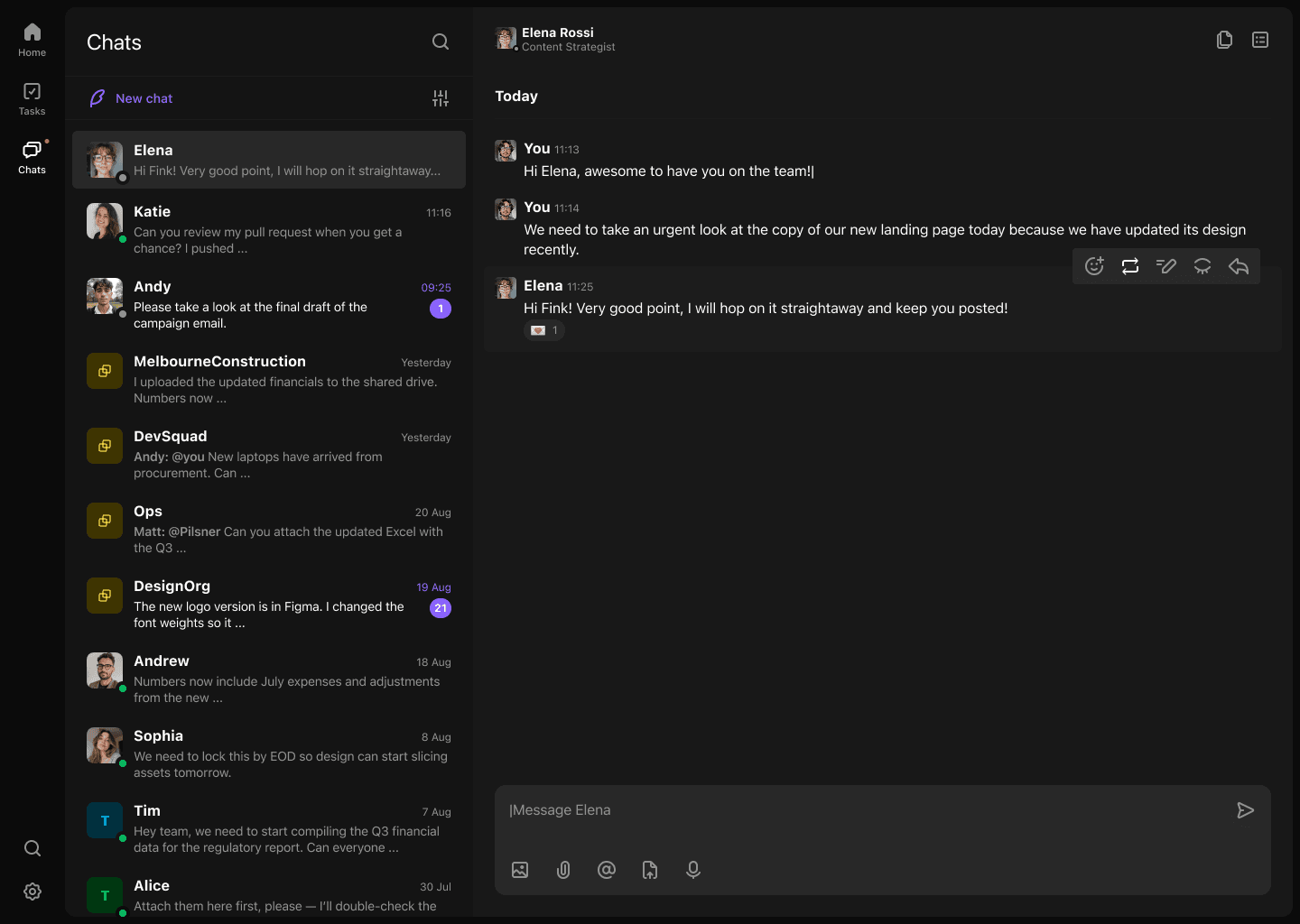
Convoe combines team chat (channels, threads, DMs, file sharing) with full task management (boards, lists, calendar) in a single application. The two are not separate modules bolted together. They're architecturally connected.
That means:
- Every task links back to the conversation that created it
- Context doesn't get lost between communication and execution
- No app switching between where you talk and where you track
- One login, one interface, one source of truth
This isn't a convenience feature. It's the structural fix for the reason tasks die in chat. When the gap between communication and task management is architectural, you can't solve it with better discipline or more manual bridging.
Related: why 40% of action items die in chatKai AI included free, not as an add-on
| Feature | Convoe | Asana Starter | Asana Premium |
|---|---|---|---|
| Team chat | Yes | No | No |
| Task boards | Yes | Yes | Yes |
| Timeline view | Yes | No | Yes |
| AI task creation from chat | Yes (Kai) | No | No |
| AI summaries | Yes (Kai) | No | Yes (limited) |
| Calendar | Yes | Basic | Yes |
| Price/user/month | Free (early access) | $10.99 | $24.99 |
Asana Intelligence does not automatically create tasks from conversations. It assists with task descriptions, prioritisation, and workflow suggestions once a task already exists. Kai creates the tasks before anyone has to think about it.
And Kai is included in every Convoe plan, including the free tier. Asana's AI features require the Business plan at $30.49/user/month.
Cost comparison for a team of 10
Asana + Slack stack (typical)- Asana Starter: $10.99/user
- Slack Pro: $8.75/user
- Google Calendar (Workspace): $7.20/user
- Total: $26.94/user/month = $3,232.80/year
- All features including chat, tasks, calendar, and Kai AI
- Total: $0/user/month = $0/year
Future paid pricing: $12/user/month = $1,440/year for a team of 10.
Even at full price, Convoe costs less than Asana alone, while replacing Asana, Slack, and Calendar.
---
Where Asana still wins
An honest comparison means acknowledging where Asana is genuinely stronger.
Mature workflow automations. Asana's rules engine is more sophisticated than anything Convoe currently offers. If you have complex multi-step automated workflows, Asana handles them better today. Enterprise reporting and portfolio management. For large organisations needing portfolio views across dozens of projects, Asana's Business and Enterprise tiers have features Convoe does not yet have. Integrations. Asana has been building integrations for 15 years. Convoe is newer, and the integration library is smaller. Established workflows. If your team has been using Asana for years and has built processes around it, the migration cost (time, disruption, rebuilding automations) is real. That's a legitimate consideration.Asana is a better choice if: you're running a 500-person enterprise with complex project portfolios, your team's processes depend on specific Asana automations, or you need integrations with legacy enterprise systems.
Convoe is a better choice if: you're tired of the Slack-Asana manual bridging problem, you want AI to handle task creation automatically, or you're paying for tools that don't talk to each other.
---
The team that switched from Asana to Convoe
Liam ran a 12-person digital marketing agency. His team used Asana for projects and Slack for communication. On paper, it was the standard setup.
In practice, tasks were getting lost weekly. Client feedback discussed in Slack never made it to Asana. Action items from campaign reviews disappeared between the call ending and someone opening the task tool. Liam spent 30-45 minutes every Monday morning excavating last week's Slack history for things that should have been tasks.
He switched the team to Convoe in February 2026. Setup took 20 minutes for the whole team. By the end of week one, the Monday excavation session was gone. Kai was catching every action item from client calls, campaign discussions, and internal reviews. The Asana board that had required constant manual attention was replaced by a Convoe board that populated itself from conversations.
The team also dropped Slack. One less subscription, one less context switch, one less place to lose work.
---
Side-by-side: Convoe vs Asana
| Capability | Convoe | Asana (Starter) | Asana (Premium) |
|---|---|---|---|
| Native team chat | Yes | No | No |
| AI task creation from conversations | Yes (automatic) | No | No |
| Kanban/board view | Yes | Yes | Yes |
| List view | Yes | Yes | Yes |
| Timeline/gantt view | Yes | No | Yes |
| Calendar view | Yes | Basic | Yes |
| Unified calendar with tasks | Yes | No | Yes |
| AI included free | Yes | No | No |
| Mobile app | Yes (iOS) | Yes | Yes |
| Price | Free (early access) | $10.99/user/mo | $24.99/user/mo |
---
Which one is right for your team?
Choose Asana if:- You're running a large enterprise with complex cross-project portfolio reporting
- Your team depends on specific Asana workflow automations that would take months to rebuild
- You need a specific integration that Convoe doesn't yet offer
- You're not experiencing significant task loss from the chat-to-task gap
- Your team uses Slack and Asana separately and tasks regularly fall through the cracks
- You're spending real time every week on manual task creation from chat
- You want AI to handle the chat-to-task bridge automatically
- You'd prefer one tool instead of two (or four)
- You're budget-conscious and can't justify $20-30/user/month for tools that don't talk to each other
For most small-to-mid-sized teams, the Slack-Asana stack is solving a problem Convoe eliminates by design.
---
Try Convoe free
If the gap between where your team talks and where work gets tracked is costing you time and missed commitments, Convoe is worth trying.
Every feature is available during early access at no cost. Kai AI is included. No credit card required. Setup takes 2 minutes.
Get Early Access to Convoe and see how many tasks Kai creates from your first week of conversations.Also see: Convoe vs Slack comparison for teams evaluating both comparisons together.
---